

My wife and I are on the couch watching TV. An entirely forgettable show. September 2026. A Red Bull ad comes on: a pink devil in yellow polka dot shorts leans on a boiling cauldron, holding a spoon as tall as he is. Long pointed nose, stick legs, bare feet. I snap a picture of the screen with my phone.
Suddenly, Déjà vu.
A flashback.
I’m in a laundromat1 in Bensonhurst and my mom is folding warm, dried clothes. 20th Avenue, between 80th and 81st Streets.2 I am six years old.
On the walls of that laundromat hang posters with cute characters, and captions that make no sense to me. I’m sitting on the orange plastic laundry chairs, bouncing around because tablets don’t exist yet, and I’m stuck in the real world.
The cartoon posters keep me occupied as I read out the slogans. A farmer holding a pitchfork, an undertaker, an angel with a harp.3 These laundromat posters4 will embed themselves deep in my unconscious, so much so that a stupid Red Bull ad will trigger a hit of nostalgia 30 years later. The Red Bull devil reminds me of the farmer with the pitchfork on that laundry wall.
I remember seeing these posters in a few other laundromats over the years. They were probably common. I’m sure there are blog posts and subreddits about them.
I’m back in front of the TV, now with a device, thinking “I wonder what the story with those laundry signs was?” A small personal mystery to be resolved with a quick Google search.
Turned out to not be that quick or easy. I searched every permutation of “old laundromat sign,” and nothing was coming up. No images, no historical blog posts, no Laundry Sign Subreddits. ‘Probably common’ became, ‘maybe it was a hallucination?’
I went back to watching the TV while my fingers kept scrolling the infinite Google Image page results. Out of the corner of my eye, I finally saw him. A hit that would unexpectedly take over the next two weeks of my life.
There he was: an undertaker, a stovepipe hat, a long mischievous face, hands folded. DON’T DYE HERE was the caption. DYE, not DIE. Of course, six-year-old me would never get the joke.
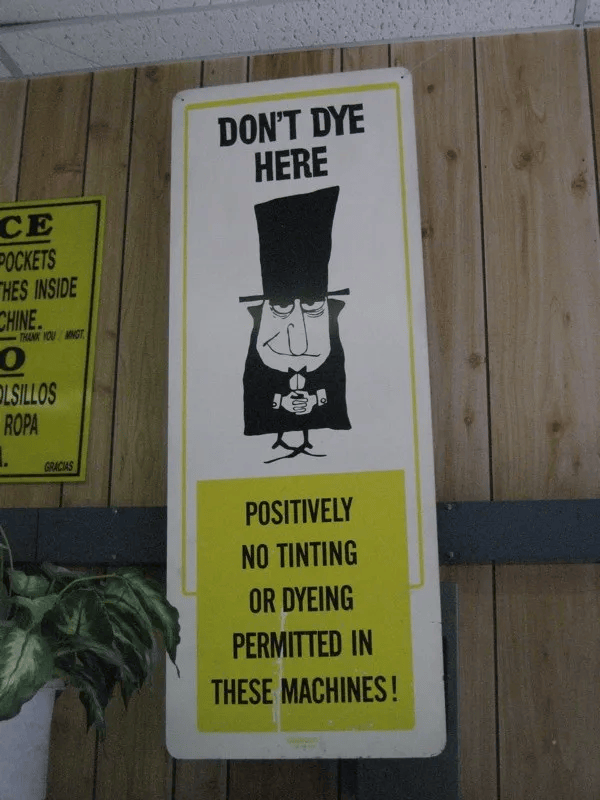
I assumed these were common, and that somebody, somewhere had a blog post with the whole set. Nobody did. There was almost no documentation at all. I tried a reverse image search on the one hit, and nothing.
The following weekend I had a sinus infection and was laid out sick. Normally I would doom scroll or veg out in front of the TV. But the mystery was too good. So it was just me, my AI models and the Undertaker, telling me not to Dye.
The first theory was the storefronts.
I remembered the storefront from that childhood laundromat because it looked just like a hundred other NY laundromat stores that I’ve seen since then. Maybe that was part of a package deal that sold signs, machines and interior posters. Find whoever made the outside sign, or opened one of the laundromats, and maybe you’ve found whoever made the inside ones. There were a lot of local neighborhood chats about these vintage storefronts, but their origin story seemed to be lost to history as well.5

The franchise concept and the NY concentration of these LAUNDROMAT signs eventually led to the mafia. Laundromats were a cash business, and New York’s coin machine trade has a real, documented history with organized crime, going back to the slot machine raids of the 1930s.6 So these coin operated self-service machines would be perfect for a mob connection.
So I went through Kefauver-era material, FBI files, Abner Zwillman, a company called Rona Metered Equipment.7 Plenty of mob and laundromats. No laundry signs.
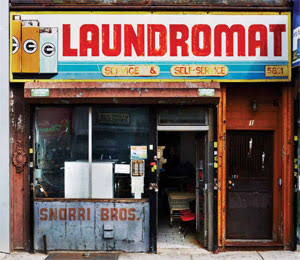
I had an AI agent searching Google Maps, laundromat by laundromat, photo by photo. Soon another hit, at 54 Fifth Avenue in Park Slope, in a photo a stranger posted in July 2019,8 the undertaker appeared again. Wooden walls, gray electrical boxes, and the undertaker (image above).
The big break came when I stopped treating the signs as decoration and started treating them as titles. Maybe they weren’t just cute wordplay, but copyrightable phrases.9
And it hit. THE hit.
DON’T DYE HERE. BE AN ANGEL. YA BETTER WATCH OUT. The prints did get copyrighted, and the register listed them by title. In the 1960 Catalog of Copyright Entries they sat under a name I’d never seen: LAUNDESIGNS. Author of the print: Joseph Schorr.

JOSEPH SCHORR.
We had the name responsible for the signs. And at a date much earlier than expected.
I assumed that they were from the 80s or 90s, from when I was a kid. They were registered on March 15, 1960. The ones on the wall in Bensonhurst were probably originals, the work of a little known, now forgotten sign maker from Queens, staying on the same walls even as ownership changed half a dozen times (I know, I checked the deed records for that property).10
After that it was more record searching for my AI friends and me. American Coin-Op, a trade magazine for laundromat owners, scanned on the Internet Archive, where Schorr Sign Service of 67-15 Myrtle Avenue, Glendale ran the undertaker in May 1961 under the headline “We know, it’s a Grave Situation.”11 Now we had an address, in Queens.12

Perhaps this sign phenomenon was NY based, or at least a disproportionate percent of the distribution.13
Years of census records followed. The 1940 census, with Joseph’s father Nathan listed as a self-employed sign painter in Corona and Joseph, 17, in the same house.14 A 1928 Queens directory with a Schorr Sign Co. on Roosevelt Avenue.15 City property records showing Joseph and his wife Elsie taking a $16,000 mortgage on 67-43 Myrtle in October 1963. A 1968 city board approval for a glow-in-the-dark exit sign he called the Egressign, a word that appears nowhere else on earth.16


I was doing historical research, with no background in history or research. Every new hit was a dopamine surge like I’d never felt before. Every new breadcrumb opened a dozen more possibilities.
This stupid Red Bull ad that triggered a childhood memory turned into one of the most gratifying projects I’ve worked on in years, and somewhere in there I may have become one of the world’s foremost experts on these silly little laundry signs.

Who drew them is still open. There’s no record of Joseph Schorr as an artist, but the 1950 census lists him, at 27, as a show card writer in the printing department of a retail drug chain: the person who hand lettered a store’s display and price cards.17 That was ten years before Laundesigns. His father, Nathan, was a self-employed sign painter in Corona from at least 1930.
I suspect that he may have used mail-order clip art from a company like the Harry Volk Jr. Art Studio of Pleasantville, New Jersey, which mailed clip books of line art to subscribers,18 made them bigger and created cute captions around them. Unfortunately, most of the Harry Volk collection is lost and the artists have been made anonymous with the passage of time.
My evidence that Schorr didn’t draw them is circumstantial: not a single character in the series relates to laundry. As if someone was creatively using stock images with captions to tie them in.19 And Schorr himself never listed any artwork, and no pieces attributed to him exist.
The search is ongoing. Everything found so far, every sign, every record and every dead end, is in an open file for the record: Schorr Signs. If you remember one of these on a laundromat wall, tell me where or leave a comment below.
Join the search.
Notes
1 Laundromat started as a brand name. Westinghouse used it as its trademark for its automatic washer, and the coinage is credited to George Edward Pendray, the Westinghouse publicist behind the 1939 World’s Fair time capsule. The country’s first self-service laundry opened earlier, on 18 April 1934 in Fort Worth, Texas, and called itself a washateria. Laundromat won, and the trademark became an everyday word. ↩
2 8015 20th Avenue, Brooklyn Block 6287, Lot 4: one storefront with a single apartment upstairs. In the 1940 city tax photo it’s a bakery, next door to Sklar’s Delicatessen (see it). On 17 March 1953 the city’s Board of Standards and Appeals let the owner, Leo Gershenhorn, convert the store from a former bakery to a self-service laundry. So the laundromat had been running for seven years before the first Laundesigns were registered. Today it’s Lucky 99 Laundromat. New York State corporation records show a 20th Ave. Launder Center Inc. formed in Kings County on 29 September 1988 at this address. ↩
3 The farmer is HOWDY NEIGHBOR: WELCOME TO YOUR FRIENDLY COIN-OP CENTER. Let our modern equipment save you time and money. The undertaker is DON’T DYE HERE: POSITIVELY NO TINTING OR DYEING PERMITTED IN THESE MACHINES! The angel is BE AN ANGEL: Help us keep this place clean and appealing. PLEASE PUT REFUSE IN WASTE BASKETS. All the known titles are in the Sign Catalog. ↩
4 They weren’t posters. The 1962 ads describe silk-screened enamel on rigid Marlite, completely framed in stainless steel, washable with a damp sponge. Marlite was a glossy plastic-faced hardboard, the same panel many laundromats used to line their walls. A tape measure in a seller’s photo puts one at about 18 inches wide by 48 tall. ↩
5 The storefront design is its own mystery, paused for now: red block letters, a row of porthole washers, a SERVICE and SELF SERVICE strip. The search logged it at 137 Fifth Avenue, 269 13th Street, 342 Waverly Avenue, 471 Fifth Avenue, 671 Franklin Avenue, 729 Meeker Avenue, 3144 Fulton Street, 5821 Fifth Avenue and 8015 20th Avenue, my laundromat. Except that the city’s 1980s tax photo of my laundromat shows the storefront shut and blank, with no sign at all; the plain LAUNDRY sign on that row is two doors down, at 8019. So the LAUNDROMAT sign I remember went up later, most likely after the building changed hands in 1988, and almost certainly wasn’t part of a package with the 1960 signs inside. The Snorri Bros photographed New York laundromats from 2008 to 2012 for their book. Nobody has named the sign maker. ↩
6 In September 1934 Mayor Fiorello La Guardia had the first of about 1,200 seized slot machines dumped into Long Island Sound off Eatons Neck. Frank Costello, called the king of slots, moved his machines to New Orleans. ↩
7 The Kefauver Committee investigated organized crime across the country in 1950 and 1951, with televised hearings. Abner “Longie” Zwillman ran Newark’s rackets, was a major focus of that investigation, and died on 26 February 1959, ruled a suicide; his FBI file is public in the FBI Vault. Rona Metered Equipment and Federal Automatic turned up in that material. One 1951 account found along the way says Zwillman had an interest in Federal Automatic, which leased about 700 washing machines to Newark housing projects. I haven’t rechecked that one, so treat it as a lead. ↩
8 The laundromat at 54 Fifth Avenue has worn several names. New York State records show Ozzie’s Stop ‘N’ Wash Inc. formed in Kings County on 6 February 1987; it is now inactive. By the time of the photos it was Rob’s Stop ‘N’ Wash, and Google lists it as Stop-N-Wash. The survey went through every borough but Staten Island in a single day. This was the only wall that turned up. ↩
9 Titles and short phrases can’t be copyrighted. The signs went in as prints, listed under Works of Art, each with a K number, sixteen in all: March and April 1960 and November 1961. The claimant, Laundesigns, was never a corporation; New York State has no record of the name. The catalog’s description of the undertaker is the best line in the file: Comic Dracula wearing top hat. ↩
10 City property records online for 8015 20th Avenue begin in 1970; Leo Gershenhorn owned it in 1953. In August 1970 a couple sold the building to a realty company formed in Manhattan three weeks earlier, and held its mortgage until 1985. It sold again in 1988, twice in 1997, first to two partners and then to one of them, in 2007 for $670,000 and in 2009 for $790,000. Six deeds in 39 years. The couple who owned it before 1970 would have owned it when the signs went up. ↩
11 American Coin-Op was the trade monthly for coin laundry owners. The Internet Archive’s collection page shows 22 issues; guessing the web addresses turned up every month from 1962 to 1979, 216 issues that aren’t listed anywhere. Schorr’s ads ran from May 1961 into 1963. Readers circled a number on a postcard to get a Free Brochure picturing the latest signs. No copy of that brochure has surfaced. ↩
12 Schorr rented at 67-15 Myrtle Avenue. In June 1963 Coin-Op announced the move to 67-43 Myrtle, a 3,000 square foot plant for waterless decals, signs and other coin-op dealer aids. Joseph and Elsie bought the building that October and owned it for 35 years. Today it has a blue awning and a roll-down gate, and nothing of the shop. ↩
13 Not only New York. Signs have since turned up in Felton, California, where one hung in the town laundromat for more than 40 years; in Trumansburg and Rensselaer, New York; in a home laundry room in Alabama; and with a seller near Philadelphia. The 1961 ads sold them nationally by mail. ↩
14 The family was hard to find because the 1940 census taker’s handwriting was so bad that the household is indexed under the name Belson. In 1950 Ancestry’s transcriber read Joseph’s job, show card writer, as Straw Card Writer. ↩
15 Schorr Sign Co. moved along Roosevelt Avenue: Corona in 1928, Woodside in 1932, Winfield in 1937, when the proprietor listed was a Lupie Wechsler. Who founded it is not documented. ↩
16 City Board of Standards and Appeals, 1968, approvals 163-68-SM and 164-68-SM, Schorr Sign Service as owner and applicant: a plastic exit sign and a phosphorescent egress sign called the Egressign. ↩
17 Joseph’s 1942 draft card gives his employer as Mallman Bakery and describes him as six feet, 180 pounds, blond, blue-eyed. His sister Bella’s husband, Harry Sandler, was a commercial artist at a Manhattan art studio in 1940 and still at an art studio in 1950. The family, year by year: Joseph Schorr: Biography and Family. ↩
18 Harry Volk Jr. Art Studio sold Clip Books of Line Art by subscription, about five dollars a month, to small ad agencies, print shops and house organs. Most of what survives online was scanned by Bart Solenthaler from books rescued from the New York Times art department. The closest in style are Volk’s Clichés (1958) and Wackies (1959). ↩
19 Two of the figures have since turned up outside the signs. The straitjacket man from WE’RE NOT RESPONSIBLE is sold today as CSA Images stock art, although I suspect that they may have knocked off one of the signs many years ago. And the sheepish man on WE’RE SORRY is a near twin of the pitchman in Stan Freberg’s 1958 Butter-Nut coffee commercial, but this could simply be a stylistic match and not the same hand. ↩
Be First to Comment